
- Home Page
- Accepted
Paintings & Copies - Doubtful
Attributions - Doubtful Textual References
- Alternative
Titles - Collectors &
Museums - Bibliography
- Search Abecedario
- Watteau &
His Circle
Paravent Blondel de Gagny
Entered April 2026

Presumed lost
Oil on canvas
Measurements unknown
RELATED PRINTS
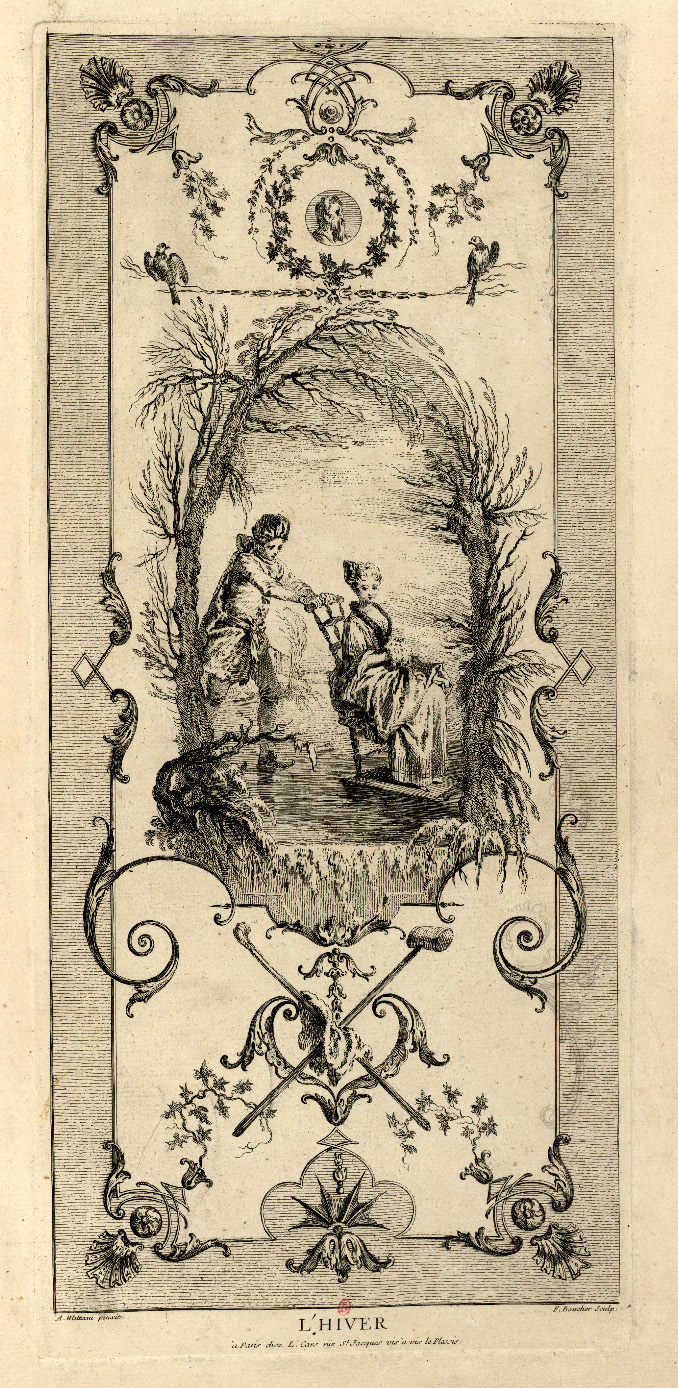
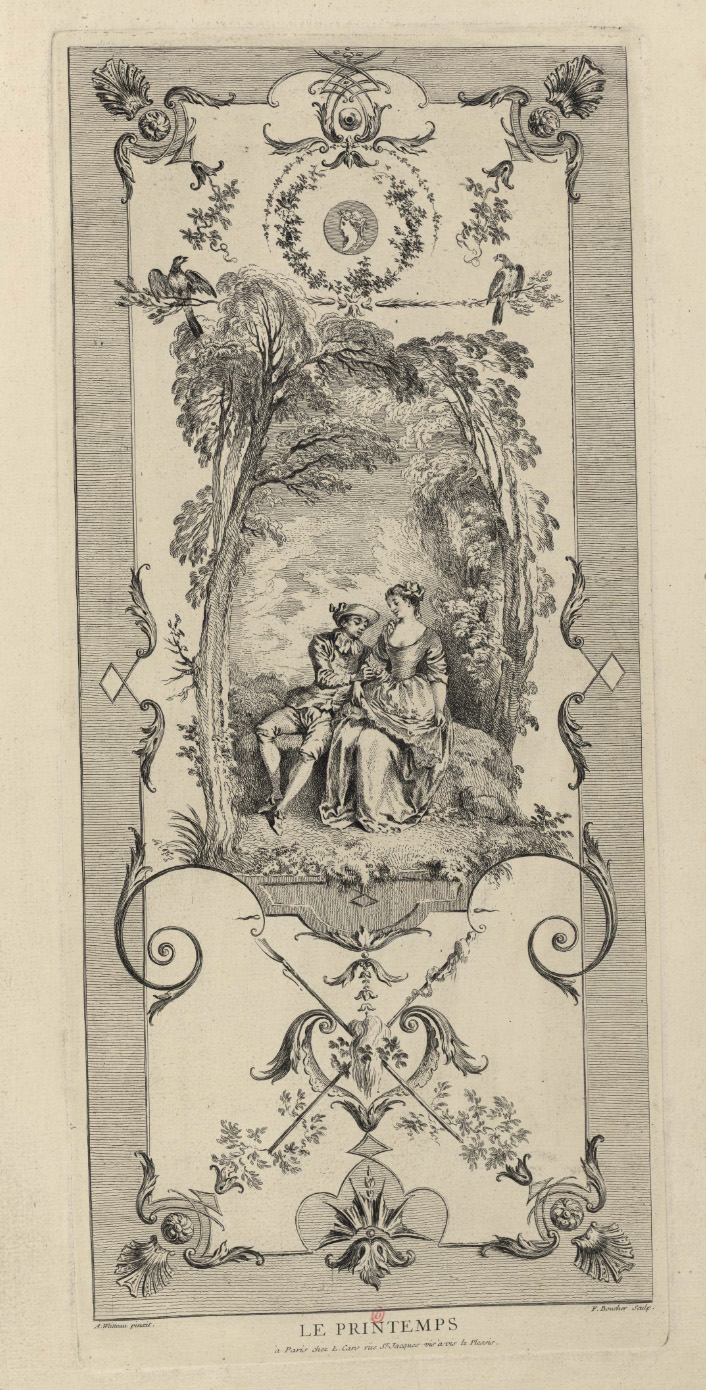
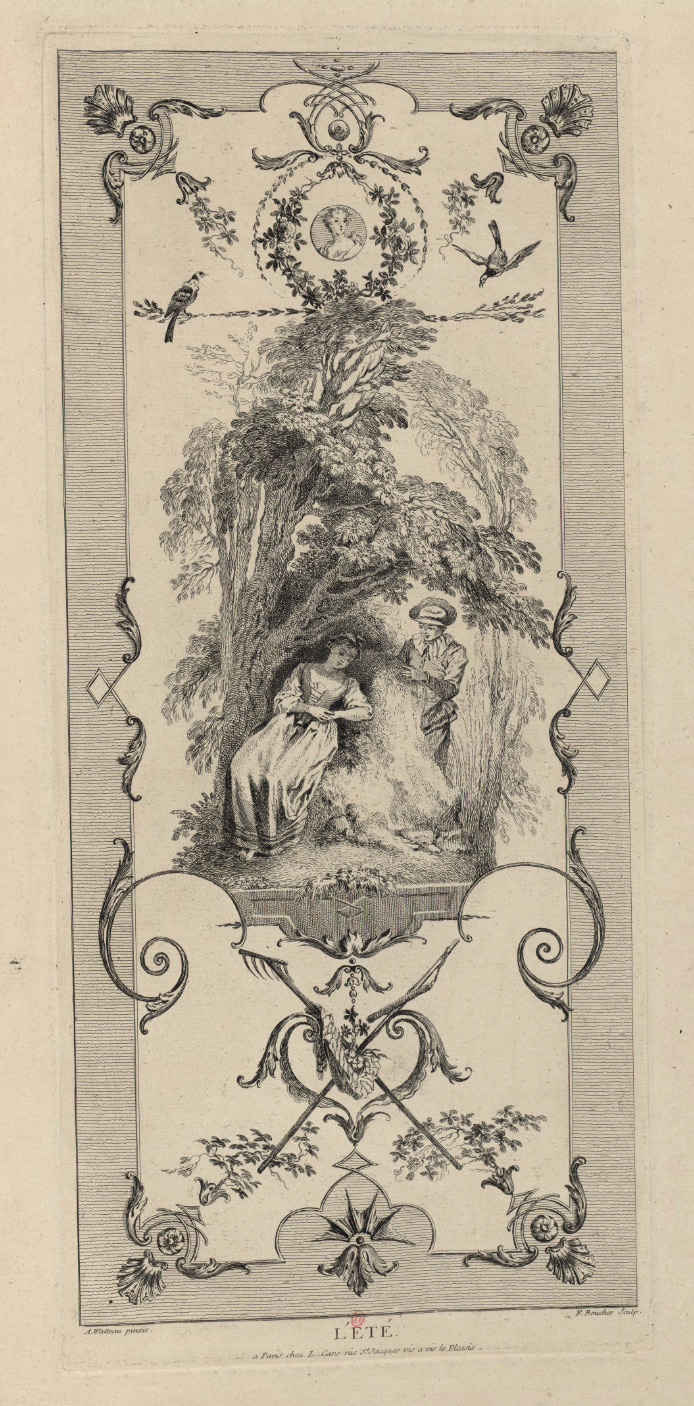
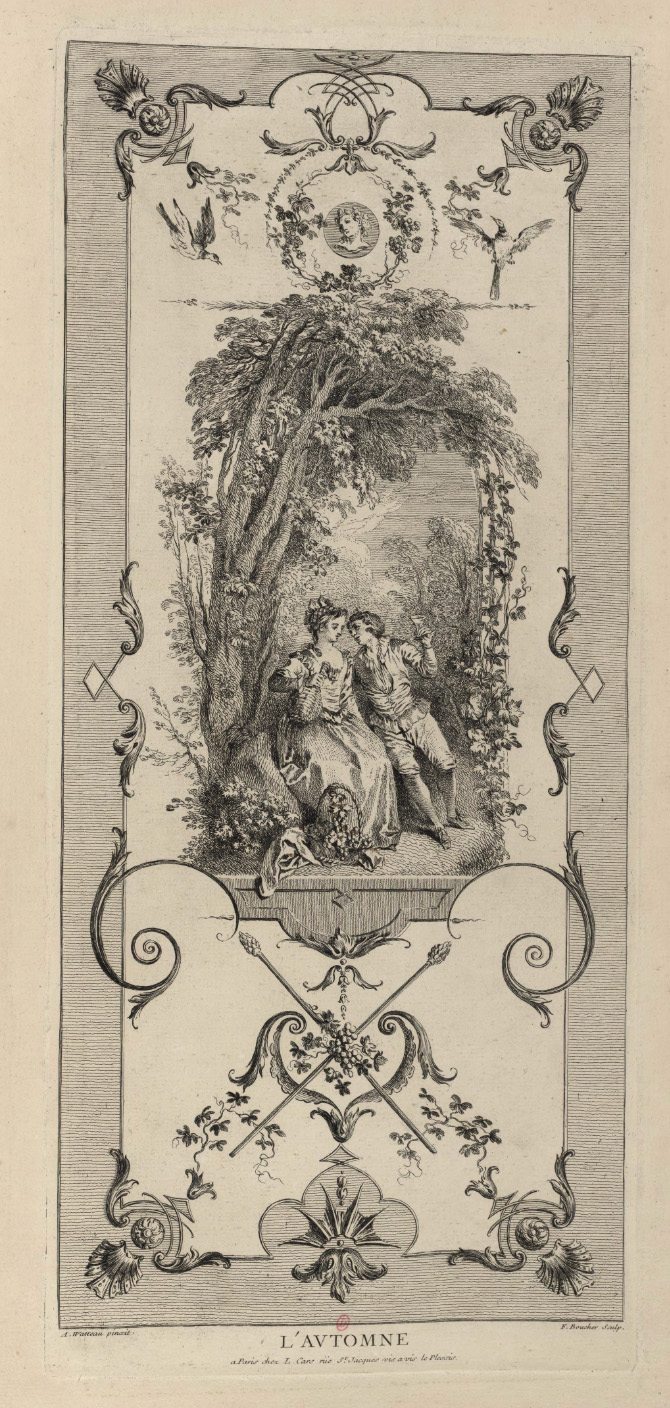
François Boucher and Laurent Cars, after Watteau. L’Hiver, Le Printemps, L’Été, and L’Automne, engravings.
The four arabesques were etched in reverse by François Boucher, and engraved by Laurent Cars. The prints were executed in the late 1720s or ’30, but because they were not advertised for sale, they cannot be dated more precisely.
PROVENANCE
Paris, collection of Augustin Blondel de Gagny (1696-1776; general treasurer of the Caisse des Amortissements and supervisor of the Menus-Plaisirs du Roi). His probate inventory, no 308: “un paravent a quatre feuilles peints par Vateau & Audran prisé 400 livres” (MC/ET/LVII/529, fol. 65 verso). His sale, Paris, December 10, 1776-January 22, 1777, lot 1137 (in supplément): “Un paravent de quatre feuilles peintes à l'huile, d'une face, composé de tableaux de forme ovale, représentants les saisons, par Antoine Watteau, entourés de guirlandes de fleurs & fruits, avec des trophés [sic] haut & bas, & renfermés dans des bordures en ornements, par Audran, du Luxembourg ; l'autre face est garnie de taffetas rayés vert & blanc.” Sold for 1300 livres to Alexandre Joseph Paillet, according to an annotated copy of the catalog in the Institut National d’Histoire de l’Art. However, as the screen subsequently appeared in the collection of his son, Blondel d’Azaincourt, one might conclude that the screen passed by inheritance.
Paris, collection of Barthélémy Augustin Blondel d'Azaincourt (1719-1794, conseiller intendant et contrôleur général de l’Argenterie, Menus-Plaisirs et Affaires de la chambre du roi). His sale, Paris, February 10, 1783, lot 35: “[ANTOINE WATTEAU]. Quatre Tableaux de forme ovale, représentant des figures agréables sur des fonds de paysages, & composant ensemble un Paravent. Ces quatre morceaux sont plein de mérite et de finesse, & du bon tems de ce Maître.” Bought for 700 livres by Alexandre Joseph Paillet.
Paris, collection of Jean Corneille Laurent Landgraffe (d. after 1792; jeweler and art dealer). His sale, Paris, Boileau, December 21, 1784, lot 202 (in the supplément): “Un Paravant de quatre feuilles, sur chacune desquelles est ajusté un Tableau de forme ovale: ces quatre Tableaux, légèrement peints, & touchés avec esprit, représentent les Saisons. Ce meuble de distinction étoit placé dans le Cabinet de M. Blondel de Gagni.” Sold for 800 livres to “Dubois” (according to an annotated copy of the catalogue in the Institut National d’Histoire de l’Art)—probably Jean François Joseph Dubois, bourgeois de Paris.
SELECT BIBLIOGRAPHY
Mariette, “Notes manuscrites”, 9: 198, nos. 51-54.
Goncourt, L'Art au XVIIIème siècle (1860), 59.
Goncourt, Catalogue raisonné (1875), cat. 257-60 and 284-87.
Mantz, Antoine Watteau (1889), 23.
Mantz, Antoine Watteau (1892), 31.
Josz, Watteau (1904), 127, n. 2.
Pilon, Watteau et son école (1912), 129, 187.
Rahir, Watteau, peintre d’arabesques (1922), 9, cat. 26-29.
Dacier, Vuaflart, and Hérold, Jean de Jullienne et les graveurs (1921-29), 3: cat. 68-71.
Réau, "Watteau" (1928), cat. 253-56.
Adhémar, Watteau (1950), cat. 26.
Macchia and Montagni, L'opera completa di Watteau (1968), cat. 33A-D.
Jean-Richard, L’Oeuvre gravé de Boucher (1978), cat. 159-163.
Roland Michel, Watteau (1981), cat. 71-73.
Glorieux, À l'Enseigne de Gersaint (2002), 230-31.
Eidelberg, “How Watteau Designed His Arabesques” (2003), 76-78.
RELATED DRAWINGS
Watteau’s reliance on his drawings is amply demonstrated apropos of those for the Paravent Blondel de Gagny, where he called on both studies from the model and compositional drawings.
François Boucher and Laurent Cars, after Watteau. L’Hiver, engraving.
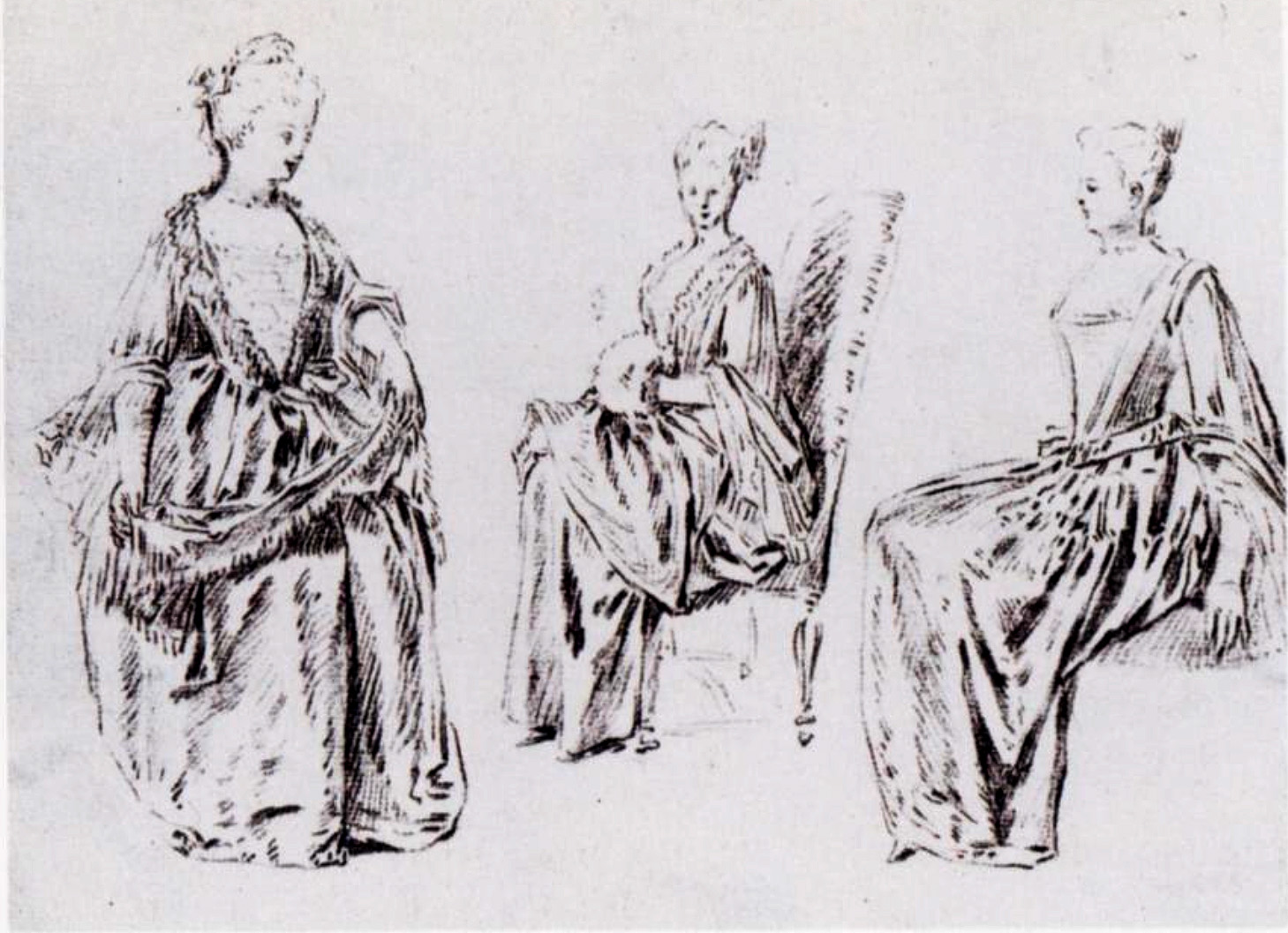
Anonymous draughtsman after Watteau. Three Studies of a Woman, red chalk, 16 x 21 cm. Whereabouts unknown.
The central motif in L’Hiver—a woman seated on a chair fashioned into a sled—was partially derived from one of Watteau’s studies from the live model. That drawing of the model, in three different poses, is no longer extant but it was recorded in a copy by an anonymous draftsman. As will be seen, Watteau, often economical in his use of his drawing, borrowed another of the figures from this sheet for a second leaf of the de Gagny screen.
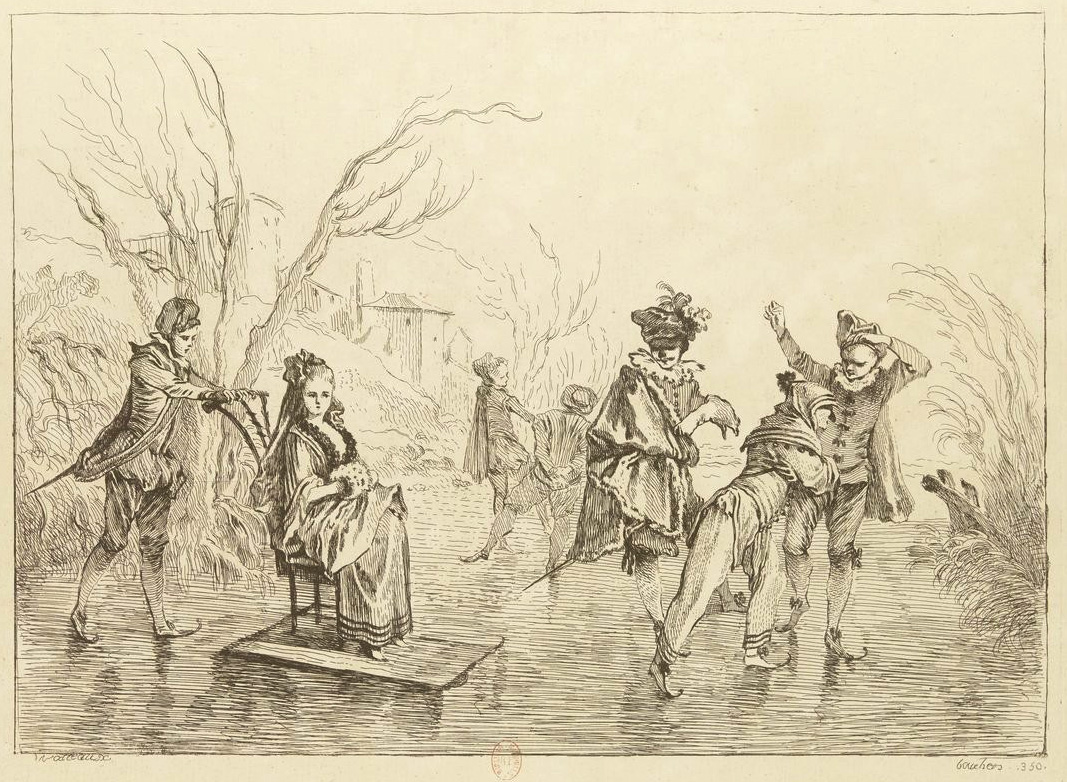
François Boucher after Watteau. Winter, engraving.
In addition, Watteau employed the seated woman, her hands protected in a muff, for a compositional study of wintry diversions, where her sled is pushed by a young gallant. This compositional drawing is also no longer extant, but its appearance was recorded in an etching by the young François Boucher (Rosenberg and Prat G130). Whether the motif of this couple was invented first for the screen or for the compositional drawing is not evident.
François Boucher and Laurent Cars, after Watteau. Le Printemps, engraving.
Anonymous draughtsman after Watteau. Three Studies of a Woman, red chalk, 16 x 21 cm. Whereabouts unknown.
Apropos of the leaf representing Le Printemps, Watteau based the figure of the seated woman, her shawl across her lap, on a study from the model that is recorded at the left on the previously cited sheet of three studies. It is noteworthy that the artist used this lost sheet for two separate leaves of the one screen, thereby offering an unexpected glimpse into his “economical” studio practice. This is not the only instance where he took advantage of the proximity of drawings.
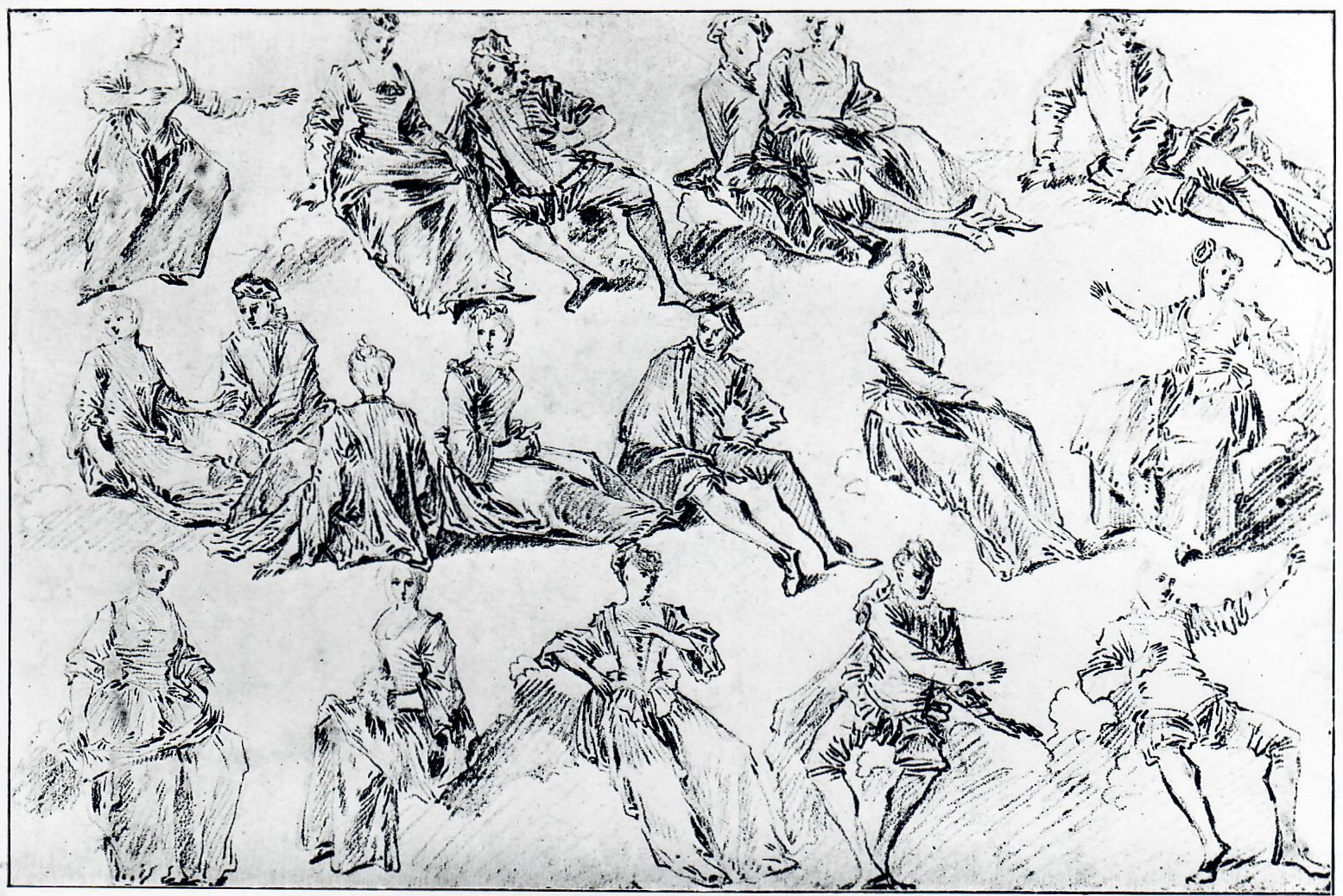
Pierre Antoine Quillard after Watteau, Sheet of Studies, red chalk. Whereabouts unknown.
Indeed, a sheet by his student, Pierre Antoine Quillard, showing eighteen figures, all copied from inventions by Watteau, demonstrate this practice. Quillard’s sources were all early Watteau drawings, as is attested by their proportions, their ungainly, angular poses, and the paintings with which they are related. It is little wonder that several figures on this single sheet are related to ones on the de Ganay screen.
In the bottom row, the woman seated at the far left, her scarf across her lap, and the woman to the right of her, her hands protected in a muff, were both in a lost drawing, side by side. In turn, they were also recorded by an anonymous copyist. Watteau used these two figures for Le Printemps and L’Hiver, respectively. Again, the original proximity of Watteau’s studies to each other played a significant role. Finally, we might consider the man seated in the bottom row, second from the right—his arm across his chest, his legs splayed but crossed at the ankles. He corresponds to the lover in Le Printemps. Quillard’s drawing not only records his presence in Watteau’s studio but also demonstrates how Watteau took advantage of the evident proximity of the three studies when he composed the de Ganay screen.
REMARKS
François Boucher and Laurent Cars, after Watteau. L’Été, engraving.
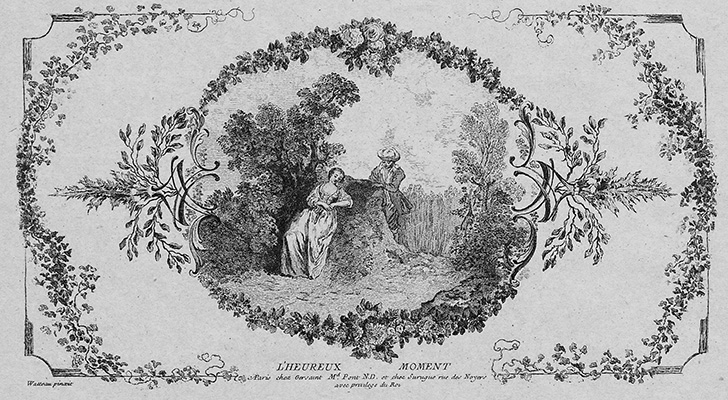
Louis Crépy fils after Watteau, L’Heureux moment, engraving
On several occasions, as is the case here, Watteau reused portions of his already existing arabesques to create new ones. Thus the figurative elements in L’Eté reappear with little change in an overdoor design engraved under the name L’Heureux moment. As often occurs, it is difficult be sure which version came first.
Apropos of Watteau’s work as a painter of arabesques, scholars have frequently quoted a passage in several early vitae writtenby Mariette (and repeated byLeclerc, Jullienne, Gersaint, Dezallier d’Argenville, and Caylus) –all of whom claimed that the young artist was hired by Claude III Audran to paint the central portions of Audran’s arabesques, those portions which contained figurative elements. This separation of the two artists’ talents has been repeated so many times that it is now an established truth. However, this literary gambit is far from the truth. While they worked together on various projects, there was no such clear cut division of labor. As is shown by many of the drawings for arabesques in Stockholm and elsewhere, Watteau’s talents as a designer of arabesques extended to designing the decorative enframements. And as is established by the few extant arabesques painted by him, such as those in Valenciennes, Watteau excelled in designing and painting both parts of his arabesques.
The first descriptions of this screen refer to the issue of artistic responsibilities in a most unusual way. The 1776 probate inventory of Blondel de Gagny’s collection cites the screen as “four leaves painted by Vateau & Audran” [“un paravent a quatre feuilles peints par Vateau & Audran ”]. Similarly, the actual sale catalogue specifies a screen composed of paintings of oval form representing the seasons by Antoine Watteau. And then the catalogue went on to specify that the oval compositions were accompanied by “garlands of flowers & fruits with trophies, top and bottom, and enclosed within ornamental borders, by Audran of the Luxembourg “de guirlandes de fleurs & fruits, avec des trophés haut & bas, & renfermés dans des bordures en ornements, par Audran, du Luxembourg”]. Does this binary attribution reflects what had been gleaned from early biographies, or did they have special information about this project ? It is a singular question.
There has been general agreement amongst the scholars who have discussed the date of the screen. Adhémar suggested, 1708-09. Macchia and Montagni claimed 1708, while Roland Michel proposed 1708-10. Yet Rosenberg and Prat have dated the drawing of the seated woman related to L’Été as c. 1712, thereby implying a later date for the whole of the painted cycle.
Click here for copies of Paravent Blondel de Gagny